Location: San Pedro de Atacama, Chile
Rundown: Drove thirty hours north from Santiago to explore the bizarre landscapes in the Atacama desert.
The Road
Headed out Saturday morning to celebrate the week off for Chile's Bicentennial in our own fashion: a road trip to see the country and know it a little better!

The green and gray mountains around the Santiago area faded rather quickly, turning into rocky slopes, and then to flat planes of sand. Dust-devils whirled all around the ribbon of road that sliced through the desert.

We drove until late in the night, found a spot off the road, and slept in our R.V... the tiny, tiny car. Slept well enough, undisturbed by banditos despite the complete lack of cover (Completely kidding, Chile is exceptionally safe!), and set of heading north again with bright eyes and bushy tails.

Just outside of the coastal city of Antofagasta there is an immense stone hand reaching out of the sand towards the sky.

It has been 'tagged' by a bunch of wing-nuts who thought it an accomplishment to buy a can of spray paint. Way to go guys. Don't get me wrong, Antofagasta, like all the costal in northern Chile has a view of the beautiful blue Pacific. However, the area is desert, dry and sandy. If you're driving through the night and you can't see your surroundings, signs have helpfully been placed to let you know where you are: THE DESERT! (or is it to minimize cactus traffic accidents?)

San Pedro de Atacama
Finally drove into San Pedro de Atacama after dark. The dirt streets and single-story, mud-brick buildings are reminiscent of towns John Wayne used to ride into with his compadres. After much searching we found our 'inn', and crashed without even stopping at the local watering hole for something to cut the dust.

The area around San Pedro de Atacama has been settled since the Atacameño people as early as 1500 BC. The small stream of water that flows naturally through this area is truly an oasis and gives life to the area.

San Pedro is a quaint little town with friendly people and a unique atmosphere. We spent some time just sitting in the shade of the trees in the park next to the town's stark white church.

Atacama Salt Flats
Took off in the morning bound for el Salar Atacama, the Atacama Salt Flats. The parched, dusty landscape is occasionally split by plate tectonics or erosion, and in a few lucky spots, water accumulates, letting little ecosystems thrive.

Back in the dry landscape a few kilometers away from the water-filled canyon a herd of llamas munched on the tough golden grass.

They paused for a picture or two, but didn't want to have much to do with us!

Drove into the cracked salt flats in the lowlands surrounded by mountain peaks and smoking volcanoes. I didn't expect that we'd see water in such an arid landscape, but sure enough, invisible in the flatlands until you're right on top of it, a shallow lakes popped up.

In this primordial landscape I thought it more probable to find dinosaurs roaming, but instead... pink flamingoes! Who ordered that?

Drove up into the foothills on sandy switchbacks until we came to some high altitude lagunas. The wind blew pretty fierce but the sun was out in force which kept us warm.

On the way back we found and explored an interesting quebrada, or canyon.

Erosion had left tunnels and arches to pass through. Previously fallen boulders created rooms and networks to pass through. Pretty fun stuff.

Caught a tremendous sunset over Valle de la Luna, the Valley of the Moon. The low sun casts drastic shadows and gives the whole vista an otherworldly feel.

Perched atop a high cliff over the valley was the perfect spot to watch the sun go down.

Geisers El Tatio
About 40 miles north of San Pedro there is a geyser field called El Tatio. You can be sure we wanted to see them! Now, although forty miles seems like a hop, skip, and a jump away, the trip took us a butt-aching four hours over bone-jarring washboard roads. At one point, I was convinced someone has purposely created the road to be as terrible as possible. The site is only 4 miles from the Bolivian border (big white line below)... although some massive peaks get in the way.

Just before daybreak we came over the last ridge (finally!) to see the valley below us belching tall columns of white steam.

The geysers are, for the most part, from underground pools of clear water that boils to the surface. Some of the geysers hiss and spit, others froth and boil. All send up huge pillars of lightly-sulfur scented steam.

We spent the morning hiking around the valley, trying not to step into any quiet geysers. Ran into these vicuñas grazing on the foliage that thrives off of the moisture provided by the geysers. They're something between a deer and a llama.

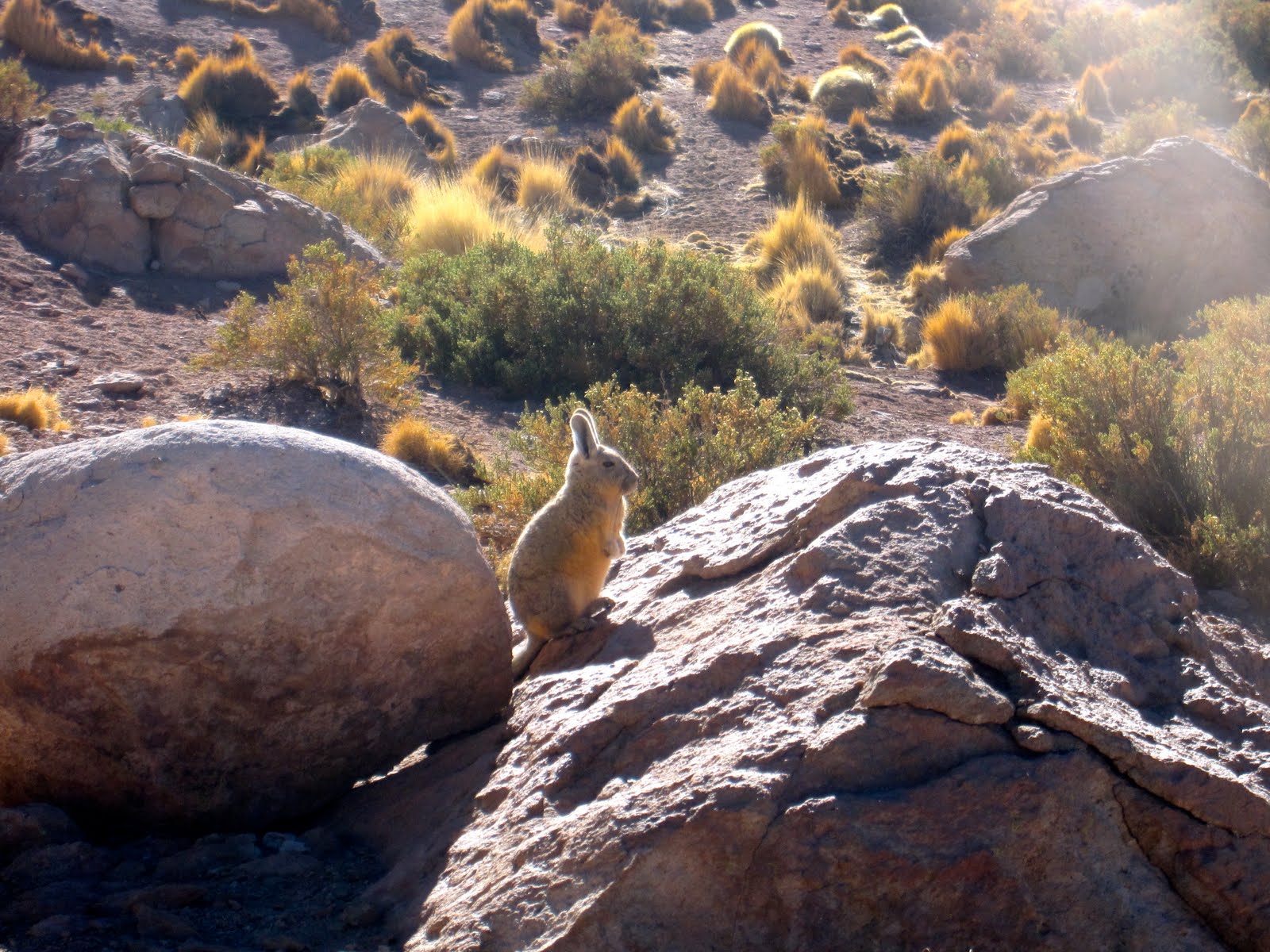
Also found a few of these chubby, bouncing guys. Viscachas look like a cross between a rabbit and a gopher, with tiny forelimbs and long ears.
Contemplated bathing, but in the early morning its so cold you'd have to stay in the hot water forever!

Again, the only word that sums up the sight is bizarre. The fuming valley ringed with hypoxic peaks and active volcanoes, populated by odd critters... it's just too much.

We were pretty excited about the whole thing. But this little guy didn't know what all the fuss was about. He was just wondering where we saw that last viscacha!

Atacameño Ruins and Quebrada del Diablo
Decided that we'd had enough of four wheels, and rented some bikes! Loaded up on water and headed out into the desert. The dirt road followed the San Pedro river north of town and we biked along it, occasionally riding across it, and stopping to soak our as it intertwined with the road. Hard to imagine any water existing out here!

A few kilometers outside of town, there are ruins of a city with defensive structures built by the Atacameño people some 700 years ago to defend against the Incan invasion, and ninety years later, the Spanish invasion. Research suggests that the Atacameño people began to settle in the region of San Pedro as early as 2000 BC. We hopped off our bikes and wandered around this dusty ruin. At the time that the Atacameño people settled here, they raised llamas and grew corn.

The people who inhabited this site left arrowheads, woven cloth, earthenware, and sculptures behind. More info on the Atacameño


Pushed on into the desert on our bikes and scouted the Quebrada del Diablo, or the Devil's Canyon. A split in the tall cliff walls opened up and a trail leads into the quebrada. The canyon twists and turns, in a few spots you ride through caves... lucky we have helmets!... in other spots the canyon is too narrow and you have to push the bike in front of you, squeeze through, and keep riding! Amazing riding with the twists and turns.

Valle de la Luna:
Set out to explore the Valle de la Luna, the Valley of the Moon, another bizarre landscape with strange rock formations with high crystal content.

Explored an abandoned salt mine. You could see the salt in the rocks, and how the miners used to chisel it out of the earth. Salt, having a crystalline structure expands when heated ever so slightly and makes audible cracking noises, like ice on the lake at the beginning of spring. It was eerie to walk through this mine and hear the rocks creaking and cracking.

Soaked up our fill of the desert for the time being and hit the road, camping out on the beach north of Caldera.

Flowering Desert:
Jumped back on the road after a brief stop in Caldera for a little breakfast of some questionable eggs and toast. Word on the street was that there had been good rainfall this year, and that an interesting phenomenon would be afoot in the desert north of La Serena. The flowering desert happens every year, but is spectacular on high rain years. So we took the road less traveled by and went to see for ourselves.

For as far as the eye could see, wildflowers sprouted out of the dry desert. The smell of them was so strong in the wind it almost seemed fake. Like something out of Willy Wonka.

Even the cacti were flowering, big, white blossoms.


Covered a lot of ground on the trip! In the same distance we could have hit Buenos Aires, or some other countries in South America.

Glad we spent some time getting to know Chile for its Bicentennial! VIVA CHILE!

Here's a little video of the trip!


